Technical Summary & Field Standards
How many screws, how much joint compound and how much tape each drywall sheet needs, with per-sheet tables for 4x8, 4x10 and 4x12 board and a basement example.
A 4 × 8 sheet of drywall on walls framed 16 in on center takes about 28 screws, about 0.3 gallons of joint compound and about 12 ft of paper tape. On a ceiling the same sheet takes about 35 screws, because screws go closer together overhead. Per 1,000 sq ft of board, plan on about 9 gallons of premixed compound and 370 ft of tape.
Per-sheet quantities
| Sheet | Sq ft | Screws, wall | Screws, ceiling | Compound (gal) | Tape (ft) |
|---|---|---|---|---|---|
| 4 × 8 ft | 32 | 28 | 35 | 0.29 | 11.8 |
| 4 × 10 ft | 40 | 32 | 40 | 0.36 | 14.8 |
| 4 × 12 ft | 48 | 40 | 50 | 0.43 | 17.8 |
Where the screw counts come from
Screw spacing for single-layer drywall is set by ASTM C840 and the Gypsum Association’s GA-216. In summary, as published by the trade magazine Walls & Ceilings: screws at most 12 in apart on ceilings, and 16 in apart on walls when studs are 16 in on center (12 in when studs are 24 in apart).
A 4 × 8 sheet hung horizontally on a wall crosses 7 studs (at 0, 16, 32 … 96 in). Along each stud, the 48 in sheet height gets a screw every 16 in: 4 screws. 7 × 4 = 28. On a ceiling, the same 7 joists each get a screw every 12 in: 5 screws, so 35. Many hangers add an extra screw near each edge, so real counts run a little higher; buy screws by the box with some to spare.
Use 1 1/4 in coarse-thread screws for 1/2 in board on wood framing and 1 5/8 in for 5/8 in board. Steel studs take fine-thread screws.
Joint compound
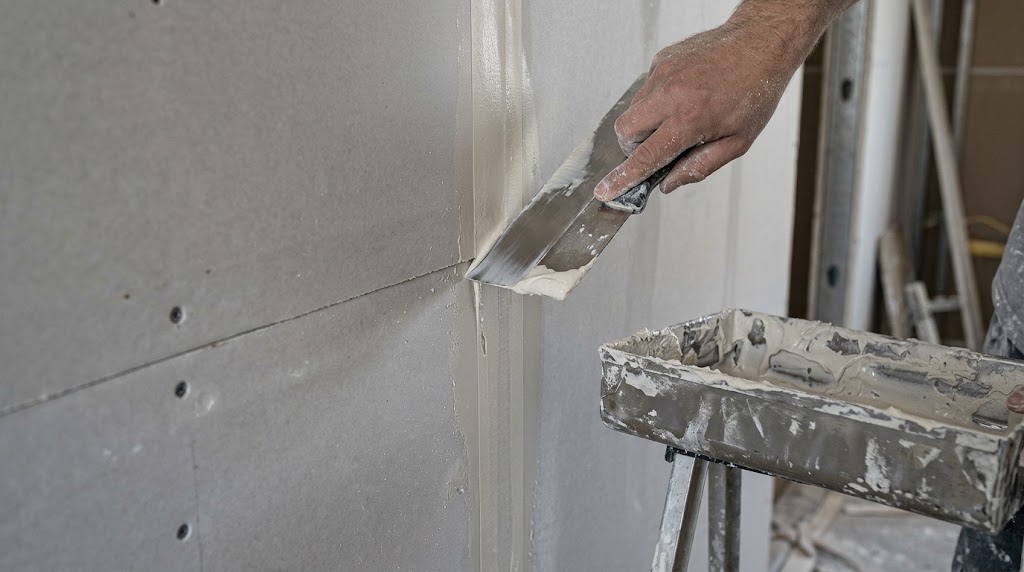
USG, the maker of Sheetrock, estimates about two 4.5-gallon pails of its premixed all-purpose compound to finish 1,000 sq ft of board. That’s roughly 0.29 gallons per 4 × 8 sheet. Your usage will vary with:
- Finish level. A smooth wall for flat paint under raking light (Level 5) takes far more than a garage wall (Level 2).
- Seam count. More butt joints and corners mean more compound. Longer sheets reduce butt joints.
- Skill. Beginners use more, and sand more of it back off.
Compound comes in three common forms: all-purpose (one product for every coat), lightweight (easier to sand, slightly less durable) and setting-type powder (mixed with water, hardens by chemical reaction in a set time like 20 or 45 minutes; good for filling deep gaps and first coats).
Tape and corner bead
About 370 ft of paper tape per 1,000 sq ft covers flat seams and inside corners. Rolls are commonly 250 or 500 ft. Outside corners need corner bead, sold in 8 and 10 ft lengths: count each outside corner’s height and round up to whole pieces. Mesh tape is self-adhesive and handy for patches, but on new work it should be used with setting-type compound.
Worked examples
Ten sheets on walls: 10 sheets of 4 × 8 on 16 in studs = 320 sq ft. Screws: 10 × 28 = 280. Compound: 320 × 9 ÷ 1,000 = 2.9 gal, one pail. Tape: about 118 ft.
A basement: 1,100 sq ft of walls and a 600 sq ft ceiling in 4 × 12 sheets, 10% waste: 26 wall sheets and 14 ceiling sheets, 40 in total. That’s about 1,740 screws, 17.3 gallons of compound (4 pails) and 710 ft of tape (2 rolls of 500 ft).
The drywall calculator totals all of this for any room. For a single room, see how many sheets a 12 × 12 room takes.