Technical Summary & Field Standards
A durable gravel driveway is built in layers 8 to 12 inches deep in total. Layers, tons of stone per layer for common driveway sizes, and how to stop ruts.
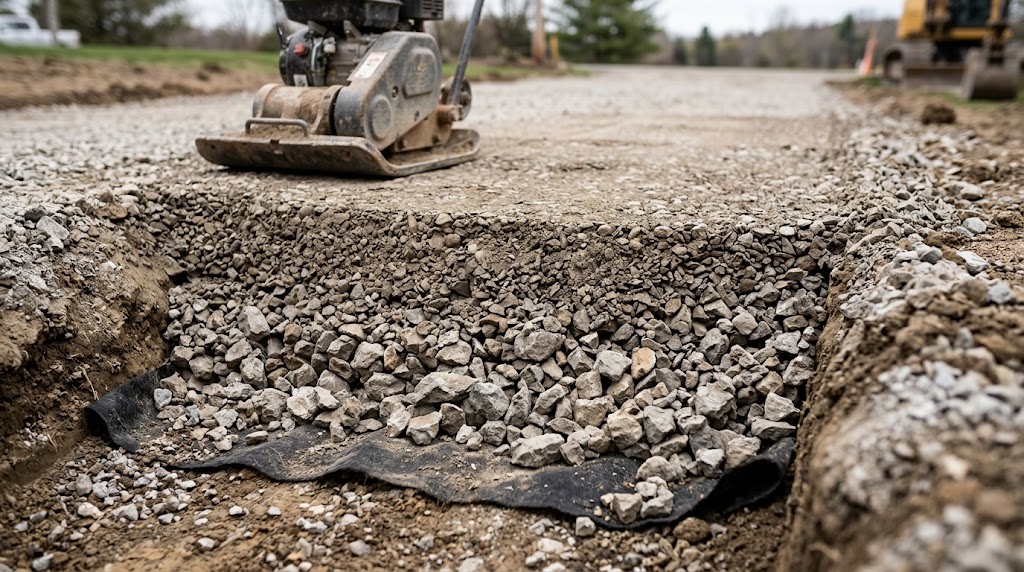
A new gravel driveway is usually built 8 to 12 inches deep in three layers: large crushed stone at the bottom, a middle layer of #57 stone, and a top layer of crusher run or similar dense-graded gravel that packs hard. Each layer is about 4 inches, compacted before the next goes on. Over firm, well-drained soil you can sometimes go thinner; over soft clay, go deeper and use geotextile fabric.
Tons per layer for common driveways
Three 4 in layers; compaction allowance 10% for clean stone and 15% for crusher run:
| Driveway | Base (tons) | Middle (tons) | Top (tons) | Total (tons) |
|---|---|---|---|---|
| Single car, short, 10 × 50 ft | 9.2 | 9.2 | 10.7 | 29 |
| Single car, long, 12 × 80 ft | 17.6 | 17.6 | 20.4 | 55.6 |
| Two cars side by side, 20 × 40 ft | 14.7 | 14.7 | 17 | 46.4 |
| Rural lane, 12 × 150 ft | 33 | 33 | 38.3 | 104.3 |
Stone names vary by region. “#3” and “#57” are common grading numbers; your supplier may call them something else, like ballast, clean stone, CA-6, road base, crush-and-run or “dense grade.” Tell them what each layer is for, and they’ll match it.
Worked example: a 12 × 80 ft driveway
- Base: large crushed stone (#3 or similar): 80 × 12 × 4 ÷ 12 = 320 cu ft, plus 10% for compaction = 13 yd³, about 17.6 tons
- Middle: #57 crushed stone: 80 × 12 × 4 ÷ 12 = 320 cu ft, plus 10% for compaction = 13 yd³, about 17.6 tons
- Top: crusher run / road base: 80 × 12 × 4 ÷ 12 = 320 cu ft, plus 15% for compaction = 13.6 yd³, about 20.4 tons
That’s roughly 56 tons in all, which is a few dump-truck loads. Order each layer separately so the truck can spread it where you need it. The gravel calculator handles any size, depth and material; for how weight and volume relate, see how much a cubic yard of gravel weighs.
Why layers instead of one stone?
- Large stone at the bottom spreads load and lets water drain away from the subgrade.
- The middle layer locks into the base and fills its gaps partially.
- The top layer has fines that bind into a hard surface when compacted and wetted, so it doesn’t roll under tires like loose round gravel.
Pea gravel and river rock are round and roll under wheels. They look nice in garden paths but make a poor driving surface.
Preparing the ground
- Strip topsoil and organic material. It compresses and holds water.
- Grade and compact the subgrade, with a crown or cross-slope so water runs off to the sides, not down the middle.
- Lay geotextile fabric over soft or clay soils. It keeps the stone from sinking into the mud, which is the main reason driveways need constant topping up.
- Add drainage where water crosses the driveway: a culvert or a ditch alongside.
Maintenance
Even a well-built gravel driveway needs a fresh top layer every few years, usually an inch or two of crusher run. Rake or grade out potholes when they appear; small ones grow quickly once water starts pooling in them.