Technical Summary & Field Standards
Most asphalt shingles come 3 bundles to a 100 sq ft square; some heavier lines take 4 or 5. A bundle chart by roof size, with waste, ridge cap and starter.
Most asphalt shingles, both 3-tab and architectural, come 3 bundles to a square, and a square covers 100 sq ft of roof. Some heavier designer shingles are packed 4 or even 5 bundles to a square; GAF, for example, notes its Woodland line comes 4 bundles per square. The wrapper on each bundle states its coverage, and that’s the number to trust.
Bundles by roof area
| Roof area | Squares | Bundles, 3/sq, 10% waste | Bundles, 3/sq, 15% waste | Bundles, 4/sq, 10% waste |
|---|---|---|---|---|
| 800 sq ft | 8 | 27 | 28 | 36 |
| 1,000 sq ft | 10 | 33 | 35 | 44 |
| 1,500 sq ft | 15 | 50 | 52 | 66 |
| 2,000 sq ft | 20 | 66 | 69 | 88 |
| 2,500 sq ft | 25 | 83 | 87 | 110 |
| 3,000 sq ft | 30 | 99 | 104 | 132 |
From the footprint to bundles
You rarely know the roof area directly. Measure the house footprint including overhangs, then multiply by the pitch multiplier (see the pitch multiplier chart). Then:
- Squares = roof area ÷ 100
- Add waste: about 10% for a simple gable roof, 15% for hips, valleys and dormers. GAF suggests adding 10 to 15% for trim and waste.
- Bundles = squares with waste × bundles per square, rounded up
Example: a 6/12 gable roof
The footprint with overhangs is 44 × 30 ft.
- Roof area: 44 × 30 × 1.118 = 1,476 sq ft, or 14.76 squares.
- With 10% waste: 16.23 squares.
- Bundles at 3 per square: 16.23 × 3 = 48.7 → 49 bundles.
- Ridge: 44 ft of ridge cap. Starter: 155 ft along eaves and rakes.
The roofing calculator does this for gable and hip roofs, including ridge cap, starter strip, drip edge and underlayment.
Why some shingles take more bundles
A bundle is sized so one person can carry it up a ladder. Heavier shingles, with thicker laminated layers or extra-large exposure, weigh more per square, so the manufacturer splits a square into 4 or 5 bundles to keep each one manageable. More bundles per square doesn’t mean more roof coverage per dollar; compare price per square, not per bundle.
Accessories that aren’t in the bundle count
- Starter strip along the eaves (and often the rakes) gives the first course a sealed edge.
- Hip and ridge cap covers ridges and hips. Some people cut cap from 3-tab shingles; most architectural lines have a matching cap product, sold by the linear foot per bundle.
- Underlayment goes under the shingles; synthetic rolls often cover 10 squares.
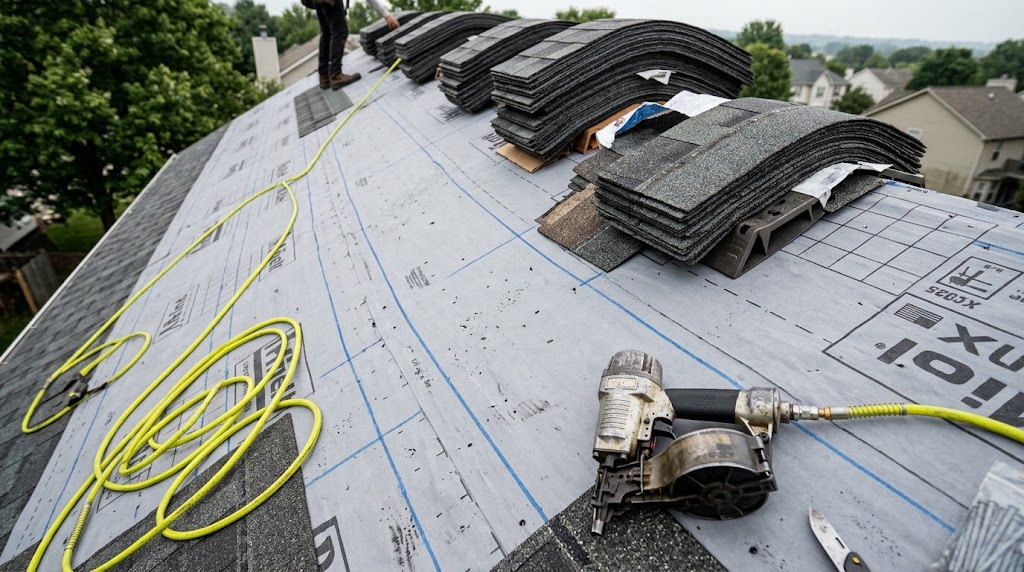
- Drip edge, flashing and vents, plus roofing nails: four per shingle on a standard installation, more in high-wind areas, following the manufacturer’s instructions.
Fastener Specifications and High-Wind Nailing Codes
Proper nailing is what prevents entire squares of shingles from blowing off in high winds:
- Nail Type and Length: Use only 11- or 12-gauge hot-dipped galvanized barbed or ring-shank roofing nails with a minimum 3/8-inch diameter head. Standard nail length is 1-1/4 inches for new decks; use 1-1/2 to 1-3/4 inches when installing hip and ridge caps or reroofing over existing layer. Never use staples or electro-galvanized drywall screws.
- Nailing Pattern (4 vs. 6 Nails per Shingle): For standard slopes up to 60 mph wind ratings, install 4 nails per architectural shingle driven along the designated nail line. In high-wind coastal or mountain zones (IRC requirements for 110+ mph zones), building codes mandate 6 nails per shingle and hand-sealing tabs with roofing cement.
- Ice & Water Shield Barrier (IRC R905.1.2): In regions where winter temperatures drop below freezing, local building codes mandate installing a self-adhering waterproof ice-and-water barrier along all eaves. The membrane must extend from the roof edge up the slope to a point at least 24 inches inside the interior heated wall line to stop winter ice dams from backing water under shingles.
Leftover bundles
Keep one or two unopened bundles for repairs after storms. Store them flat in a dry place. Shingle colors change between production runs and get discontinued, so a matching bundle years later is hard to find.
To calculate your exact roof pitch, squares, and all flashing accessories, use our roofing calculator.