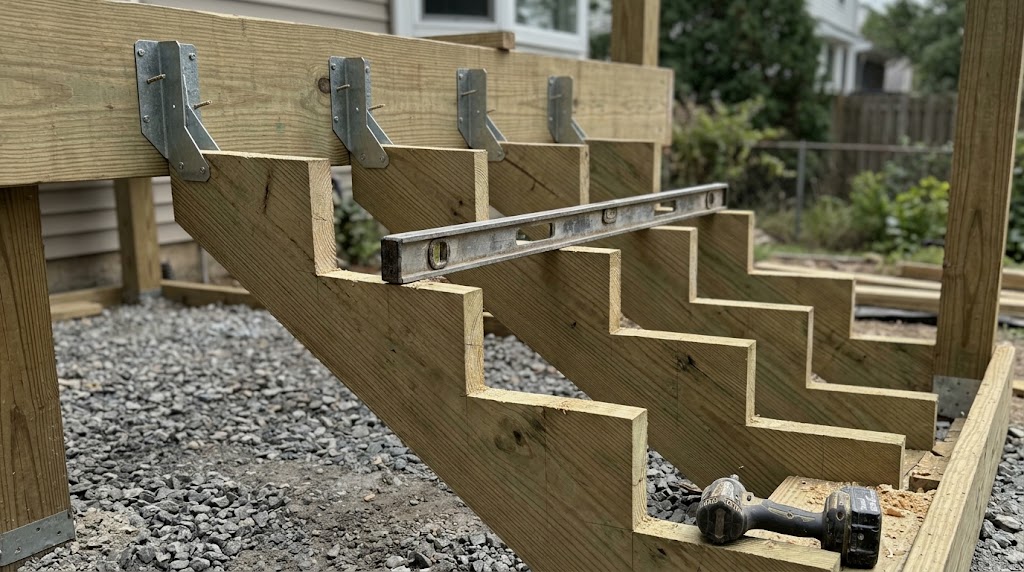
Technical Summary & Field Standards
Stringer length is the number of risers times one step's diagonal. The formula, a chart by total rise, board length to buy and the wood left after cutting.
Stringer length = number of risers × √(riser² + tread²). For a stair with 4 risers of 7 in and treads of 11 in, each step’s diagonal is √(49 + 121) = 13.04 in, so the stringer is 4 × 13.04 = 52.2 in, about 4 ft 4 in. Buy the next standard board length up. For short stairs that’s usually an 8 ft 2 × 12, the shortest length most yards stock.
Why multiply by risers, not treads?
A stair with n risers has n − 1 treads, because the top floor or deck acts as the last step. The line through the nosings is therefore (n − 1) step diagonals long. But the stringer board is longer than that line: it needs material for the level cut where it sits on the ground and the plumb cut where it meets the deck or floor. Multiplying by the number of risers adds one step diagonal, which covers both. It’s a slightly generous figure, which is what you want when buying lumber.
Stringer length chart
Risers at no more than 7 1/2 in, treads 10 1/2 in:
| Total rise | Risers | Riser height | Stringer length | Board to buy |
|---|---|---|---|---|
| 21 in | 3 | 7 in | 3 ft 1 7/8 in | 8 ft |
| 28 in | 4 | 7 in | 4 ft 2 1/2 in | 8 ft |
| 36 in | 5 | 7 3/16 in | 5 ft 3 11/16 in | 8 ft |
| 48 in | 7 | 6 7/8 in | 7 ft 3 13/16 in | 8 ft |
| 60 in | 8 | 7 1/2 in | 8 ft 7 1/4 in | 10 ft |
| 84 in | 12 | 7 in | 12 ft 7 7/16 in | 14 ft |
| 96 in | 13 | 7 3/8 in | 13 ft 10 7/8 in | 14 ft |
| 108 in | 15 | 7 3/16 in | 15 ft 11 in | 16 ft |
| 120 in | 16 | 7 1/2 in | 17 ft 2 7/16 in | 18 ft |
The stair calculator gives the stringer length and board size for any rise and tread, along with code checks. If you haven’t settled the rise and run yet, start with our guide to comfortable stair dimensions.
How much wood is left: the throat
Cutting the steps removes a triangle from the top of the board. What’s left below the notches is called the throat, and it carries the load. The depth of each notch, measured square to the board’s edge, is riser × tread ÷ step diagonal. On a 2 × 12 (11 1/4 in actual):
| Riser × tread | Step diagonal | Notch depth | Throat left on a 2 × 12 |
|---|---|---|---|
| 7 × 11 in | 13.04 in | 5.91 in | 5.34 in |
| 7 1/4 × 10 1/2 in | 12.76 in | 5.97 in | 5.28 in |
| 7 1/2 × 10 in | 12.5 in | 6 in | 5.25 in |
| 7 3/4 × 10 in | 12.65 in | 6.13 in | 5.12 in |
That’s why stringers are cut from 2 × 12s: a 2 × 10 (9 1/4 in) leaves only about 3 to 3 1/2 in of throat with typical steps. Minimum throat and maximum stringer span depend on your code and the stringer material; for deck stairs, the American Wood Council’s DCA 6 guide covers the details. Long spans may need a middle support.
Worked example: deck stairs
A deck sits 40 in above the patio. You’d like risers near 7 1/2 in and 11 in treads, and a 4 ft wide stair.
- Risers: 40 ÷ 7.5 = 5.33 → 6 risers of 40 ÷ 6 = 6 11/16 in.
- Treads: 5 at 11 in = 55 in of run.
- Step diagonal: √(6.667² + 11²) = 12.86 in.
- Stringer: 6 × 12.86 = 77.2 in (6 ft 5 3/16 in), so 8 ft 2 × 12s.
- Stringers for 48 in of width at about 16 in apart: 4.
Marking the stringer
- Set stair gauges (or clamps) on a framing square at the riser and tread dimensions.
- Mark each step along the board, keeping the gauges tight to the edge.
- Drop the bottom riser by the thickness of one tread board, so that once treads are installed every riser is the same height.
- Cut the first stringer, test-fit it, then use it as a template for the rest.