Technical Summary & Field Standards
Calculate fence post depth using the 1/3 rule and local frost line. Learn how much concrete, gravel, and post length you need for stable fence installation.
Fence posts require a minimum buried depth equal to one-third of their exposed height, or below the local frost line, whichever is greater. This ensures stability against wind loads and prevents frost heave, which can lift and misalign posts over time. Always account for a 6-inch gravel base for drainage and add a 10% waste buffer to material estimates for concrete and gravel.
The 1/3 Rule and Frost Line Calculation Method
Proper fence post depth is critical for the longevity and stability of any fence. Two primary rules dictate how deep a post hole must be: the “1/3 rule” and the “frost line rule.” The greater of these two depths, plus a gravel base, determines the total excavation required.
-
The 1/3 Rule: For optimal structural stability, at least one-third of the fence post’s total exposed height should be buried. For example, a 6-foot (72-inch) fence post exposed above ground requires a minimum of 2 feet (24 inches) buried depth. This ratio provides adequate resistance against lateral forces like wind.
- Formula:
Minimum Buried Depth (1/3 Rule) = Exposed Post Height / 3
- Formula:
-
The Frost Line Rule: In regions with freezing temperatures, the bottom of the post footing must extend below the average maximum frost penetration depth for your area. This prevents “frost heave,” a phenomenon where freezing and thawing soil expands and contracts, pushing posts upwards and out of alignment. Local building codes or agricultural extension offices can provide specific frost line depths.
- Formula:
Minimum Buried Depth (Frost Line Rule) = Local Frost Line Depth
- Formula:
-
Determining the Required Post Depth: The actual buried depth for your post will be the greater of the depth calculated by the 1/3 rule or the local frost line depth.
- Formula:
Required Post Depth = MAX(Minimum Buried Depth (1/3 Rule), Minimum Buried Depth (Frost Line Rule))
- Formula:
-
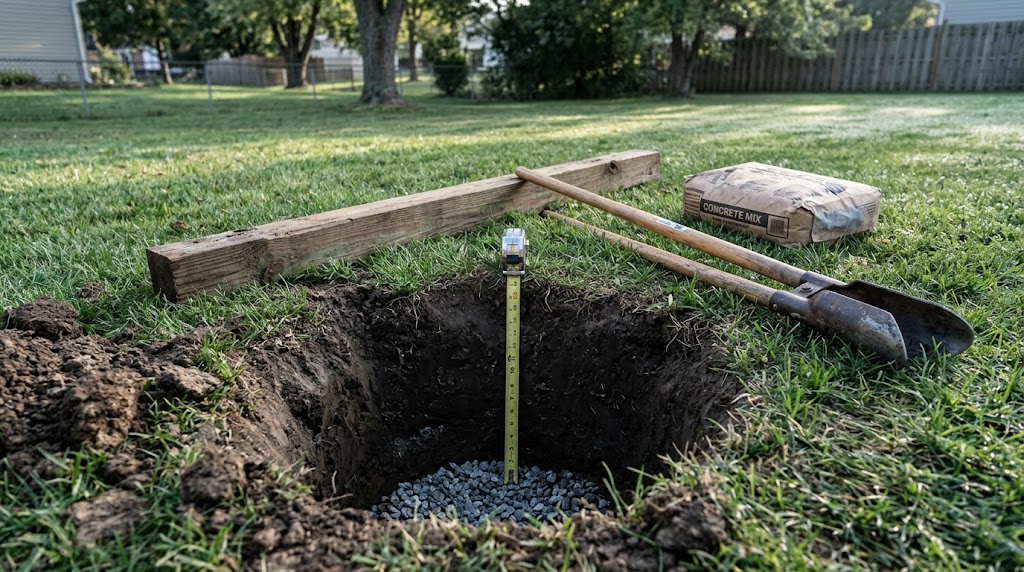
Calculating Total Hole Depth: To ensure proper drainage and prevent the post from sitting in standing water, a 6-inch (0.5-foot) gravel base is recommended at the bottom of each hole. This base is added to the required post depth.
- Formula:
Total Hole Depth = Required Post Depth + 0.5 feet (for gravel base)
- Formula:
-
Calculating Required Post Length: The total length of the post needed is the sum of its exposed height and the required buried depth.
- Formula:
Required Post Length = Exposed Post Height + Required Post Depth
- Formula:
-
Calculating Concrete Volume: Concrete is typically used to secure fence posts. The volume of concrete needed for a cylindrical hole is calculated using the formula for the volume of a cylinder. Remember to subtract the gravel base depth from the total hole depth when calculating concrete volume.
- Formula:
Concrete Volume (cu ft) = π * (Hole Diameter in feet / 2)² * (Required Post Depth) - Standard hole diameters for fence posts are commonly 8, 10, or 12 inches.
- Standard concrete bag yields: 50 lb bag ≈ 0.375 cubic feet; 80 lb bag ≈ 0.60 cubic feet.
- Formula:
You can quickly estimate your materials using our fence calculator.
Fence Post Hole Dimensions and Concrete Bags Matrix
The following table provides common scenarios for fence post installation, factoring in both the 1/3 rule and typical frost line depths. All calculations include a 6-inch (0.5 ft) gravel base and assume a 10% waste allowance for both gravel and concrete.
| Exposed Post Height | Min. Buried Depth (1/3 Rule) | Typical Frost Line Depth | Required Post Depth (Greater of 1/3 or Frost Line) | Total Hole Depth (Incl. 6" Gravel) | Required Post Length (Approx.) | Hole Diameter | Gravel Volume (cu ft, +10% waste) | Concrete Volume (cu ft, +10% waste) | 50 lb Concrete Bags (+10% waste) | 80 lb Concrete Bags (+10% waste) |
|---|---|---|---|---|---|---|---|---|---|---|
| 4 ft (48 in) | 1.33 ft (16 in) | 2.0 ft (24 in) | 2.0 ft | 2.5 ft | 6.0 ft | 8 in | 0.19 | 0.77 | 3 | 2 |
| 4 ft (48 in) | 1.33 ft (16 in) | 3.0 ft (36 in) | 3.0 ft | 3.5 ft | 7.0 ft | 10 in | 0.30 | 1.80 | 5 | 3 |
| 6 ft (72 in) | 2.0 ft (24 in) | 2.5 ft (30 in) | 2.5 ft | 3.0 ft | 8.5 ft | 10 in | 0.30 | 1.50 | 4 | 3 |
| 6 ft (72 in) | 2.0 ft (24 in) | 4.0 ft (48 in) | 4.0 ft | 4.5 ft | 10.0 ft | 12 in | 0.43 | 3.46 | 10 | 6 |
| 8 ft (96 in) | 2.67 ft (32 in) | 3.0 ft (36 in) | 3.0 ft | 3.5 ft | 11.0 ft | 12 in | 0.43 | 2.59 | 7 | 5 |
| 8 ft (96 in) | 2.67 ft (32 in) | 4.5 ft (54 in) | 4.5 ft | 5.0 ft | 12.5 ft | 12 in | 0.43 | 3.89 | 11 | 7 |
Note: Post lengths are approximate; always round up to the nearest standard lumber length (e.g., 8 ft, 10 ft, 12 ft).
Worked Example: 6-Foot Privacy Fence Post Installation
Let’s calculate the materials for a fence post with the following specifications:
- Exposed Post Height: 6 feet (72 inches)
- Local Frost Line Depth: 30 inches (2.5 feet)
- Post Type: 4x4 pressure-treated lumber
- Hole Diameter: 10 inches
Step 1: Determine Minimum Buried Depth (1/3 Rule)
Minimum Buried Depth (1/3 Rule) = 6 feet / 3 = 2 feet
Step 2: Determine Minimum Buried Depth (Frost Line Rule)
Minimum Buried Depth (Frost Line Rule) = 30 inches = 2.5 feet
Step 3: Determine Required Post Depth
Compare the two depths: 2 feet (1/3 rule) vs. 2.5 feet (frost line). The greater depth is 2.5 feet.
Required Post Depth = MAX(2 feet, 2.5 feet) = 2.5 feet
Step 4: Calculate Total Hole Depth
Total Hole Depth = 2.5 feet + 0.5 feet (gravel base) = 3.0 feet (36 inches)
Step 5: Calculate Required Post Length
Required Post Length = 6 feet + 2.5 feet = 8.5 feet
Round up to the next standard length and buy a 10-foot post.
Step 6: Calculate Gravel Volume
A 10-inch hole is 0.833 feet across, so its cross-section is π × (0.833 / 2)² ≈ 0.545 sq ft.
Gravel Volume = 0.545 × 0.5 feet = 0.27 cu ft; with 10% waste = 0.30 cu ft per hole
Step 7: Calculate Concrete Volume
Concrete Volume = 0.545 × 2.5 feet = 1.36 cu ft; with 10% waste = 1.50 cu ft per hole
Step 8: Convert to Bags
50 lb bags = 1.50 / 0.375 = 4.0, so 4 bags per post
80 lb bags = 1.50 / 0.60 = 2.5, so 3 bags per post
For a run of 10 posts with these dimensions you need about 40 bags of 50 lb concrete (or 30 bags of 80 lb) and 3 cu ft of gravel. The figures are upper estimates because the post itself displaces some concrete.
Common Mistakes to Avoid
- Using the 1/3 rule alone in cold climates. If your frost line is deeper than one-third of the exposed height, the frost line decides the depth.
- Skipping the gravel base. Concrete poured directly onto soil holds water against the post bottom and speeds up rot.
- Digging holes too narrow. A hole should be about three times the post width, so a 4x4 post (3.5 in actual) fits a 10 to 12 inch hole.
- Rounding down bags. Always round up; a half-filled hole is a weak footing.
Use the fence calculator to run these numbers for your own post height, hole size and frost line.