Technical Summary & Field Standards
Divide the fence length in inches by picket width plus gap. Picket counts per 6 and 8 ft section for 1×4 and 1×6 boards, with a full-fence example.
Pickets = fence length in inches ÷ (picket width + gap). For a privacy fence of 1×6 pickets (actual width 5.5 in) with no gap, an 8 ft section takes 96 ÷ 5.5 = 17.5, so 18 pickets; a 100 ft run takes about 219. Add about 5% for split and warped boards.
Pickets per section
| Picket | Gap | Per 8 ft section | Per 6 ft section |
|---|---|---|---|
| 1×4 (3.5 in) | none (privacy) | 28 | 21 |
| 1×4 (3.5 in) | 1.5 in | 20 | 15 |
| 1×4 (3.5 in) | 2.5 in | 16 | 12 |
| 1×4 (3.5 in) | 3.5 in | 14 | 11 |
| 1×6 (5.5 in) | none (privacy) | 18 | 14 |
| 1×6 (5.5 in) | 1.5 in | 14 | 11 |
| 1×6 (5.5 in) | 2.5 in | 12 | 9 |
| 1×6 (5.5 in) | 3.5 in | 11 | 8 |
Use actual width, not nominal
Lumber is named by its rough size. A “1×6” picket is about 5 1/2 in wide and a “1×4” about 3 1/2 in. Using 6 in for a 1×6 undercounts by about 8%, which on a 100 ft fence is roughly 18 pickets short. Some dog-ear pickets are sold as 5 1/2 in or 5 5/8 in; measure one.
Gates
Leave the gate openings out of the fence length; each gate is built as its own frame, usually with the same pickets. Count gate pickets separately: a 4 ft gate with 1×6 pickets and no gap needs 48 ÷ 5.5 = 8.7, so 9.
Worked example: an 80 ft privacy fence
80 ft of 6 ft tall fence with one 4 ft gate, 1×6 pickets, no gap, posts 8 ft apart:
- Fence line: 80 − 4 = 76 ft = 912 in.
- Pickets: 912 ÷ 5.5 = 165.8 → 166, plus 5% = 175.
- Gate: 9 more.
- Posts and rails, from the same plan: 12 posts, 30 rails, 21 bags of 80 lb concrete.
The fence calculator produces the whole list, including fasteners: 2 per picket at every rail, about 1,050 here.
Shadowbox and board-on-board
A shadowbox fence alternates pickets on each side of the rails, so it looks the same from both sides and lets air through. With 1×6 pickets and a 3 1/2 in gap between pickets on each side, each side takes 96 ÷ (5.5 + 3.5) = 10.7, so 11 pickets, and an 8 ft section takes 22, about 20% more than the 18 of a plain privacy fence. Board-on-board with a 1 in overlap works out about the same. Narrow the gaps for more privacy and the count climbs quickly.
Fastener Sizing, Nail Gun Specs, and Ground Clearance
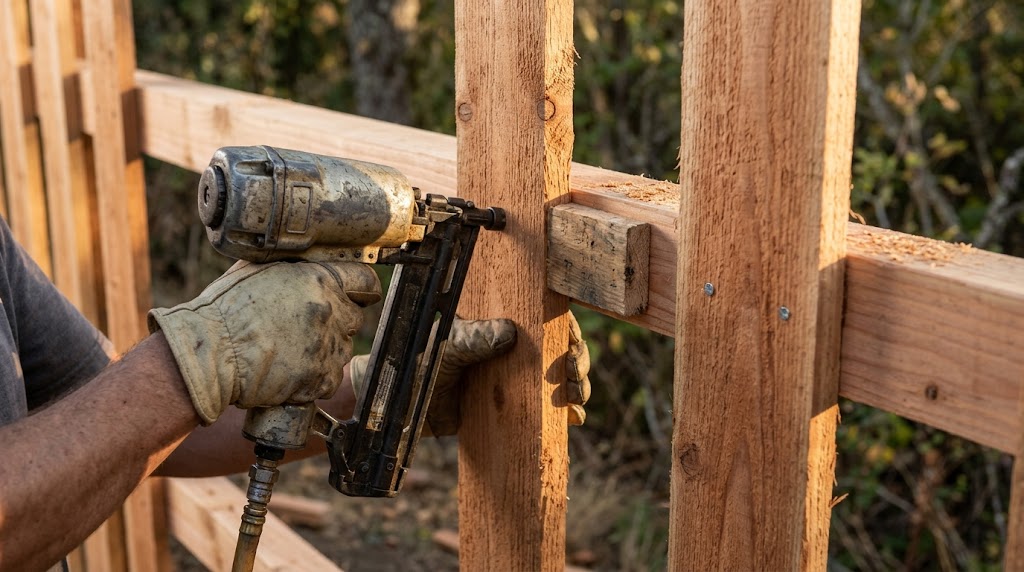
Selecting the right nails and spacing them correctly ensures your fence pickets don’t cup, twist, or tear off during storms:
- Fastener Count Formula: Attach each picket using two fasteners per horizontal rail. On a 6-foot privacy fence with 3 rails, that requires 6 nails per picket. For an 80-foot fence using 175 pickets, order at least 1,050 to 1,200 exterior nails.
- Ring-Shank Nails vs. Smooth Wire: Never use smooth-shank framing nails. Pickets expand and contract with summer humidity, working smooth nails loose within 12 months. Use 1-3/4 inch to 2-inch hot-dipped galvanized (HDG) or Grade 304 stainless steel ring-shank nails. Ring threads bite permanently into the 2x4 rail fibers.
- Ground Clearance Mandate (The 2-Inch Rule): Never install pickets touching the soil or lawn grass. Cut or snap a chalk line 2 inches above finished grade, aligning the bottom edge of every picket along this line. Direct earth contact wicks groundwater upward into end-grain wood pores, causing rot and insect infestation within 3 to 4 years.
- Western Red Cedar vs. Treated Pine Shrinkage: Wet pressure-treated pine pickets arrive saturated with chemical preservatives. When installed tight, they shrink by 1/4 to 3/8 inch across a 5.5-inch board as they bake in the sun, creating unintentional sight gaps. Western Red Cedar pickets are kiln-dried and dimensionally stable, shrinking less than 1/8 inch.
Installation Tips
- Wood shrinks. Green pressure-treated pickets shrink as they dry, opening small gaps. Many builders butt them tight for a privacy fence.
- Use a spacer block cut to your gap width so the spacing stays even.
- Check the last picket early. Lay out a section dry; if the last picket would be a sliver, adjust the gap slightly across the section.
To calculate your complete fence bill of materials including posts, rails, and bags of concrete, use our fence calculator.